How to Crate Train a Dachshund Puppy: A Calm, Positive Approach That Actually Works
Crate training a dachshund puppy can feel a little dramatic at first.
You put your sleepy puppy into a perfectly comfortable crate with a soft bed, a safe toy and everything they could possibly need.
You close the door.
And suddenly, according to your dachshund, they have been abandoned forever.
The whining starts.
Then the barking.
Then comes the tiny face pressed against the crate door as if you'd like to reconsider this terrible decision you've made.
Dachshunds can be incredibly attached to their people, so it's not surprising that some puppies need a little extra help learning to relax in a crate.
But when it's introduced properly, a crate can become one of the most useful tools you'll have during puppyhood—and eventually a comfortable place your dachshund chooses to rest on their own.
The goal isn't to teach your puppy to tolerate being locked up.
It's to teach them:
This is my safe place. I can relax here. And my people always come back.
Why Crate Train a Dachshund?
A crate can be useful for much more than bedtime.
It can help with:
Potty training
Creating a safe place for naps
Preventing unsafe puppy mischief when you can't supervise
Establishing a predictable bedtime routine
Traveling
Veterinary visits or recovery periods when confinement may be necessary
Teaching your puppy how to settle independently
That last one is especially valuable for dachshunds.
Many doxies would happily spend every waking—and sleeping—moment touching their favorite person. Teaching your puppy that it's also okay to relax independently is an important life skill.
A crate shouldn't replace interaction, exercise, training or supervision.
Think of it as your puppy's little bedroom—not puppy storage.
Choosing the Right Crate for a Dachshund Puppy
You don't need anything elaborate.
The most important thing is choosing a crate that's secure, comfortable and appropriately sized. Our puppy essentials article can help you select the right one.
Your puppy should have enough room to:
Stand up → turn around → lie down comfortably.
But during potty training, you don't necessarily want a crate large enough to create separate bedroom and bathroom areas.
If you're buying a crate your dachshund can grow into, one with an adjustable divider is especially useful. You can increase the available space as your puppy grows instead of buying several crates.
And remember the dachshund body shape.
They may be short, but they're long. Make sure your puppy can comfortably stretch out without being cramped.
Where Should You Put the Crate?
At first, don't banish your new puppy to an isolated corner of the house.
Dachshunds are social dogs, and suddenly being separated from everything familiar can make crate training much harder than it needs to be.
During the day, consider placing the crate somewhere your family spends time.
Your puppy can learn to relax inside while still hearing normal household activity.
At night, many puppies do better when the crate is initially near their owner's bed.
That doesn't mean it has to live there forever.
Once your puppy is sleeping comfortably, you can gradually move it toward the location where you'd eventually like it to stay.
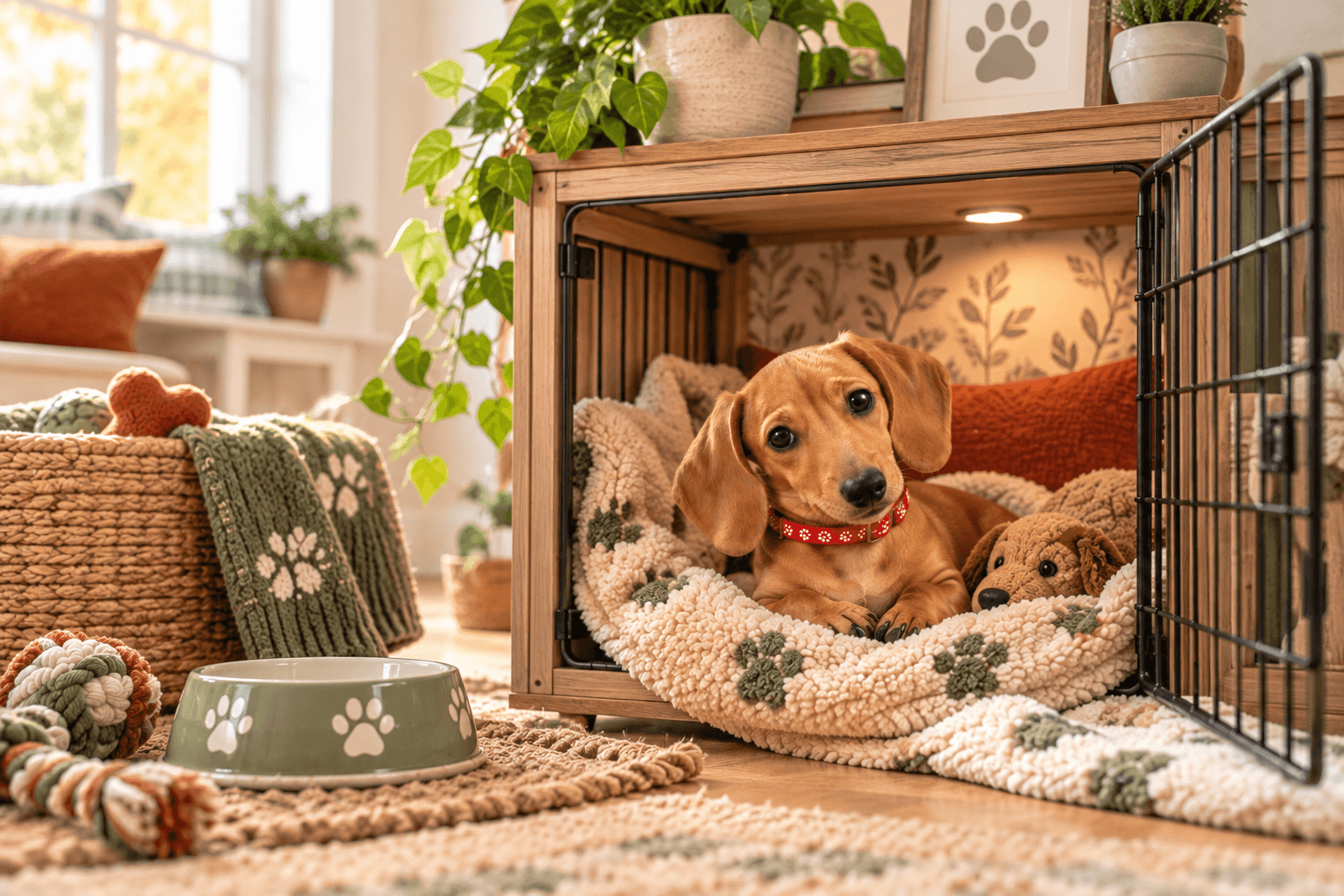
Make the Crate a Good Place Before Closing the Door
One of the easiest mistakes is introducing the crate only when you're about to leave.
From your puppy's perspective:
Crate = everybody disappears.
Not exactly the association we're trying to create.
Instead, introduce the crate throughout the day while you're home.
Leave the door open.
Toss a treat inside and let your puppy retrieve it.
Feed an occasional meal near or inside the crate.
Put a favorite safe toy inside.
Let your puppy wander in and out without immediately shutting the door every time.
If they voluntarily crawl inside for a nap?
Perfect.
That's exactly what we want.
Start With Very Short Crate Sessions
Once your puppy is comfortable entering the crate, begin closing the door for very short periods.
And by short, we mean short.
Close it.
Give your puppy a treat.
Sit nearby.
Open it again.
Nothing dramatic happened.
Gradually increase the amount of time the door stays closed.
Then begin moving around the room.
Next, briefly leave the room.
Eventually, practice stepping outside.
You're building one little success on top of another rather than going from:
“This crate seems fine.”
to
“See you after work!”
in one afternoon.
Give Your Puppy Something to Do
A safe enrichment activity can help your puppy settle in the crate.
Depending on your dog and what can be safely used without supervision, that might include a stuffed food toy, lick mat or another puppy-appropriate enrichment option.
Licking and working for food can help turn crate time into something your puppy anticipates rather than avoids.
You can even reserve one especially good enrichment activity specifically for crate time.
Suddenly going into the crate isn't such a terrible deal.
A quick safety note
Not every toy or chew is appropriate for unsupervised use.
Make sure anything left with your puppy is suitable for their age, size and chewing habits, and remove anything they could break apart or swallow.
Should You Cover a Dachshund's Crate?
Some puppies settle better when part of the crate is covered because it creates a quieter, den-like environment.
Others prefer seeing what's happening around them.
You can experiment.
If you use a crate cover or blanket, make sure there's plenty of ventilation and that your puppy can't pull loose fabric through the bars and chew it.
This is another one of those situations where there isn't one perfect answer for every dachshund.
Watch your dog.
They'll tell you which setup helps them relax.
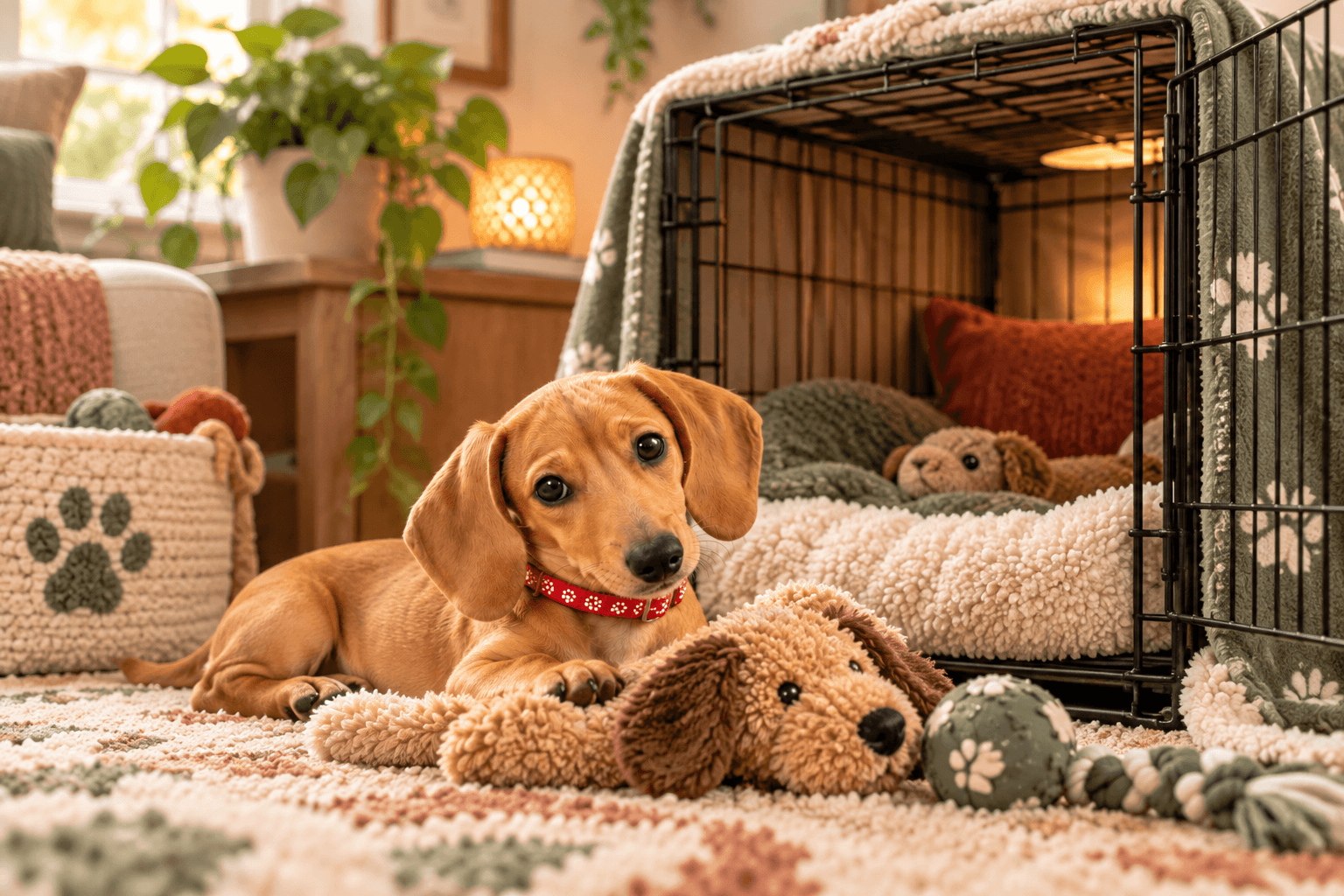
Crate Training and Potty Training Work Together
This is one of the biggest reasons crate training can be so helpful during puppyhood.
Dogs generally prefer not to potty where they sleep, so a properly sized crate can help your puppy begin learning bladder control.
But the crate does not magically give a young puppy an adult bladder.
Young puppies need frequent opportunities to go outside.
A simple routine might look like:
Wake up → immediately outside → potty → praise/reward → play/train → outside again → crate nap → immediately outside after waking.
The exact timing will depend on your puppy's age and individual needs.
If you're currently working on house training, our guide to how to potty train a dachshund goes into the entire process in much more detail.
I would hyperlink “how to potty train a dachshund” directly to the potty-training article we just created.
What Should You Do When Your Dachshund Cries in the Crate?
This is probably the question every new dachshund owner asks.
And unfortunately, the answer isn't simply:
Ignore them.
You need to figure out why they're crying.
A young puppy may genuinely need to potty.
They may be frightened because this is their first night away from their mother and littermates.
They may be uncomfortable.
Or they may simply be protesting because they'd rather sleep in your bed.
Those situations aren't all the same.
If your puppy has been sleeping and suddenly wakes crying, particularly overnight, take them outside for a quiet potty trip.
Keep it boring.
No play session.
No 2 a.m. tour of the yard.
Potty → quiet praise → back to bed.
If you're confident their physical needs have been met and they're simply complaining about being confined, give them an opportunity to settle.
You don't need to open the door at every tiny whimper.
Otherwise, your very intelligent dachshund may quickly discover:
Noise opens doors.
And dachshunds are not known for forgetting useful information.
But Don't Use “Cry It Out” for a Puppy Who Is Panicking
There's a difference between:
“I don't particularly like this arrangement.”
and
“I am genuinely terrified.”
A puppy who fusses briefly and then settles isn't necessarily in distress.
A puppy who is escalating—frantically trying to escape, biting the crate, drooling heavily or becoming increasingly panicked—needs a different approach.
Back up.
Make the next session easier.
Your goal is to build comfort with the crate, not prove that your puppy will eventually stop making noise if you wait long enough.
If confinement consistently causes significant distress, talk with your veterinarian or a qualified behavior professional.
The First Night in the Crate
Your dachshund puppy's first night at home can be rough.
Think about what just happened from their perspective.
Yesterday they slept beside their mother and littermates.
Tonight they're in a strange house with unfamiliar smells and people—and now everyone has gone to bed.
Some crying is not surprising.
Keeping the crate near your bed initially can help.
Your puppy can hear and smell you without learning that the only acceptable sleeping position is directly on top of you.
Before bedtime:
Take your puppy outside to potty.
Keep the house calm.
Avoid a huge burst of exciting play immediately before bed.
Put your puppy into the crate with whatever safe bedding or comfort items you've chosen.
Then settle down yourself.
If they need a potty break during the night, keep the trip quiet and boring and return them to the crate afterward.
It won't necessarily be a perfect night.
That's okay.
You're teaching a routine, not taking a final exam.
Should a Dachshund Puppy Sleep in Your Bed?
That decision is ultimately up to you.
Plenty of dachshunds eventually sleep with their people.
And plenty of dachshund owners will tell you they once had a bed of their own.
The dachshund had other plans.
But even if you eventually want your dog sleeping with you, there's still value in teaching them to be comfortable in a crate. Our doxies are all crate trained, yet sleep in bed with us at night.
There may be times throughout their life when they need confinement for travel, veterinary care, recovery or safety.
It's much easier if the crate isn't completely unfamiliar when that day comes.
And because dachshunds are at increased risk for spinal problems, think carefully about how your dog will safely get on and off furniture if they're eventually allowed to sleep in your bed.
If your dachshund sleeps with you, our best ramps for dachshunds and ramp training guides are worth reading too.
Don't Use the Crate as Punishment
Your puppy just shredded something they weren't supposed to touch.
You're annoyed.
Into the crate they go.
It's understandable—but it can work against everything you're trying to build.
If the crate repeatedly appears immediately after something unpleasant happens, it stops feeling like a safe resting place.
You can absolutely use the crate when you need your puppy safely contained.
But try not to make:
“You were bad, so go to your crate.”
part of the routine.
We want the crate associated with naps, treats, calm time and security.
Crate Training Can Help Prevent Too Much Freedom Too Soon
Puppies are remarkably talented at finding trouble.
And dachshund puppies come conveniently equipped with a nose that's interested in everything.
If you can't actively supervise, using a crate, exercise pen or puppy-safe area can prevent your puppy from practicing unwanted behaviors.
Chewing furniture.
Pottying behind the couch.
Finding something dangerous on the floor.
The goal isn't to keep them confined constantly.
It's to gradually expand their freedom as they demonstrate they're ready for it.
This is especially useful during potty training.
Freedom is earned one room at a time.
Crate Training and Separation Anxiety Aren't the Same Thing
A puppy complaining about being in a crate doesn't automatically have separation anxiety.
Likewise, putting a dog with true separation anxiety into a crate doesn't automatically solve the problem.
Some dogs with separation-related distress actually become more anxious when confined.
If your dachshund becomes distressed specifically when you leave—not simply when they're crated—read our guide to dachshund separation anxiety for more information about gradually teaching comfortable alone time.
How Long Does Dachshund Crate Training Take?
There's no universal timeline.
Some puppies walk into a crate on day one, curl up and apparently wonder why you didn't provide this private bedroom sooner.
Others need much more time.
Your puppy's age, previous experiences, temperament and how the crate is introduced all matter.
Instead of asking:
“How many days until my puppy is crate trained?”
look for progress.
Does your puppy enter willingly?
Can they eat inside?
Can they relax with the door closed?
Can you walk out of sight briefly?
Can they nap there?
Can they sleep there overnight?
Those small improvements tell you much more than the calendar does.
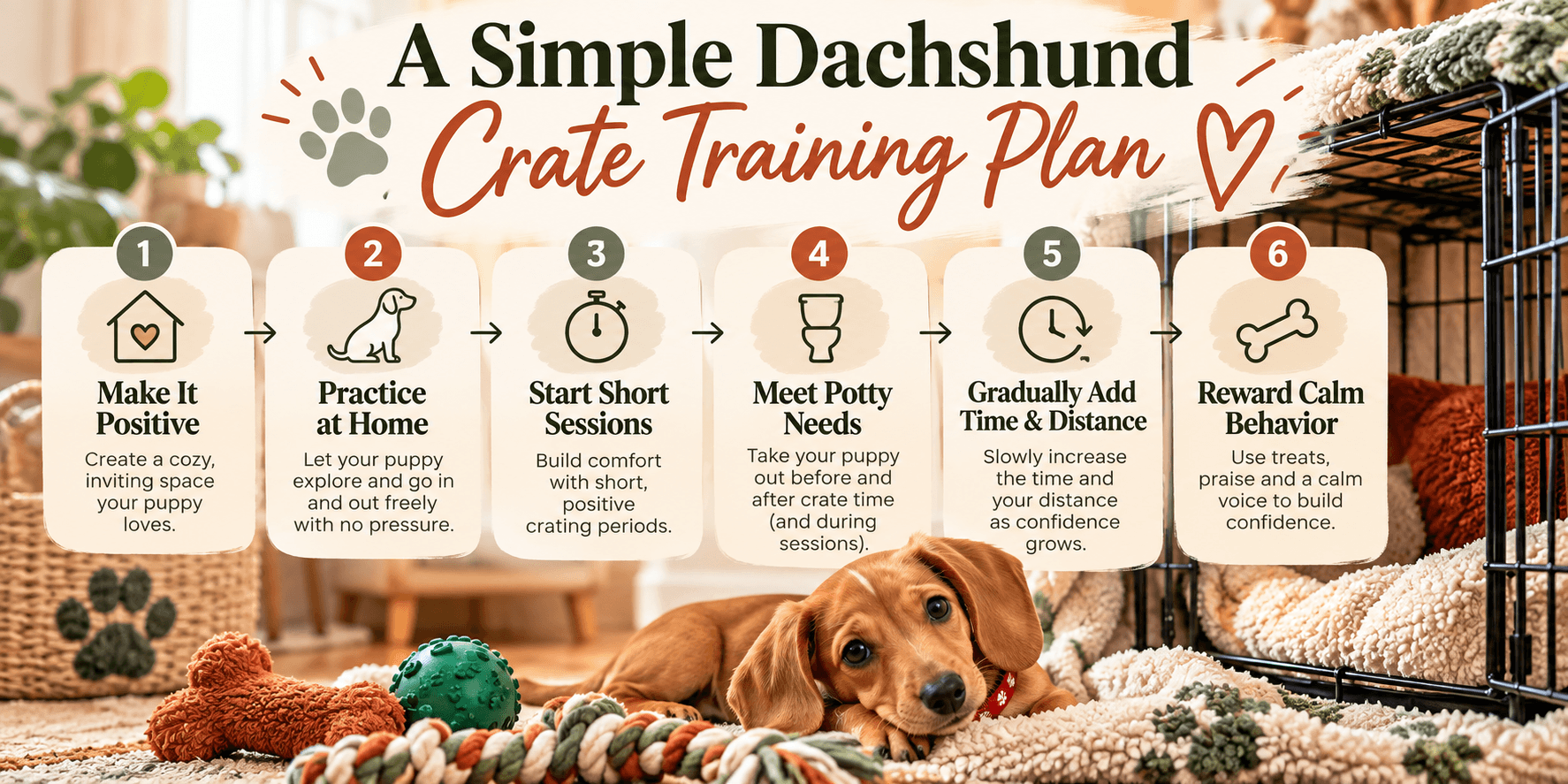
A Simple Dachshund Crate Training Plan
If you remember nothing else, remember this:
Make the crate positive → practice while you're home → start with short sessions → meet your puppy's potty needs → gradually add distance and time → reward calm behavior → don't rush.
Crate training doesn't need to become a battle between you and your dachshund.
In fact, with a dachshund, I strongly recommend avoiding battles of will whenever possible.
They have impressive stamina.
Instead, make the behavior you want feel safe and rewarding enough that your puppy starts choosing it.
The Goal Is a Dachshund Who Feels Safe in Their Crate
A well crate-trained dachshund doesn't have to love every moment they're confined.
They just need to understand that the crate is safe, temporary and predictable.
Eventually, you may find your dachshund wandering into the crate on their own for a nap.
And that's the real win.
Not a puppy who has learned they can't get out.
A puppy who has learned:
I can relax here.
For a tiny dog with a very big opinion about where their people should be at all times, that's a pretty important skill.