Dachshund Separation Anxiety: Why They Hate Being Left Alone & What Helps
If your dachshund follows you from room to room, supervises every trip to the bathroom, and somehow knows the exact moment you're thinking about leaving the house, you're probably familiar with the dachshund version of personal space.
There isn't much of it.
Dachshunds can form incredibly strong bonds with their people. It's one of the things we love most about them. But for some dogs, that attachment can make being left alone genuinely difficult.
A dachshund who whines when you leave isn't necessarily being dramatic or stubborn. And a dog who destroys something while you're gone isn't automatically being naughty.
Sometimes they're bored. Sometimes they haven't learned how to settle alone yet. And sometimes what you're seeing may be separation-related anxiety or distress.
Understanding the difference matters—because the solution isn't simply telling your dachshund to get used to it.
Why Are Dachshunds So Attached to Their Owners?
Dachshunds may be independent thinkers, but many are extremely people-oriented at home.
They were originally bred to hunt, and that history helped create a dog that's bold, persistent, alert and very tuned in to what's happening around them.
Modern dachshunds also tend to become deeply attached to their families.
Which can create a funny combination:
Independent enough to ignore you when you call them.
Attached enough to follow you into the bathroom two minutes later.
Being your shadow doesn't automatically mean your dachshund has separation anxiety. Plenty of dachshunds simply prefer being wherever their favorite person happens to be.
But dogs also need to learn that being alone is safe.
For some dachshunds, that skill takes practice.
Is It Really Separation Anxiety—or Does My Dachshund Just Hate Being Alone?
Not every unhappy dog has clinical separation anxiety.
Your dachshund might bark because someone walked past the window. A puppy might chew something because puppies chew things. A bored dog may go looking for entertainment.
True separation-related distress generally involves anxiety associated with being separated from a person or people the dog is attached to.
Possible signs can include:
Persistent barking, whining or howling after you leave
Pacing or inability to settle
Destructive behavior, particularly around doors or windows
Scratching or attempting to escape
Drooling or panting unrelated to heat or exercise
Indoor potty accidents despite otherwise reliable house training
Refusing food or treats when left alone
Becoming distressed when you begin your normal leaving routine
Intense excitement or difficulty settling when you return
One behavior by itself doesn't necessarily tell you what's happening.
The pattern matters.
A Camera Can Tell You a Lot
If you're not sure what your dachshund does after you leave, a basic indoor camera can be incredibly useful.
You may discover that your dog barks for two minutes, circles the couch three times and then sleeps for the next three hours.
That's very different from a dog who remains distressed throughout your absence.
Video can help you see when the behavior begins, how long it lasts and whether your dachshund eventually settles.
It's also useful information to share with your veterinarian or a qualified behavior professional if the problem is significant.
Start Teaching Alone Time Before You Need It
One of the best times to teach a dachshund to be comfortable alone is before being alone becomes a major event.
This is especially important with puppies.
If someone is home with a new puppy constantly for the first several weeks, the puppy may never get a chance to learn:
People leave—and they come back.
Practice tiny separations while you're still home.
Walk into another room.
Close a door briefly.
Give your puppy something safe to do while you step away.
Return before the situation becomes overwhelming.
Over time, those tiny experiences can help make separation feel normal rather than alarming.
Start With Very Short Absences
If your dachshund already struggles when you leave, don't begin training by disappearing for four hours and hoping they figure it out.
Start smaller.
Depending on the dog, that might mean leaving for a few minutes.
For a dog with more severe distress, it might initially mean stepping outside for only seconds.
The goal is to practice separation at a level your dachshund can handle without becoming highly distressed.
Then gradually increase the duration.
This is one area where slower can actually get you there faster.
Repeatedly pushing a dog far beyond what they can tolerate doesn't teach them that being alone is safe. It gives them more opportunities to experience being alone as frightening.
Make Departures Boring and Predictable
You don't need to sneak out of your own house.
But you also don't need a five-minute emotional goodbye.
Try creating a calm, predictable leaving routine.
Potty break.
A little exercise or sniffing.
Settle into their safe area.
Offer an appropriate enrichment activity if your dog will use one.
Leave calmly.
The more ordinary departures become, the less they need to feel like an event.
The same idea applies when you return.
Of course you're happy to see your dachshund—and they're probably extremely happy to see you—but allowing everyone a moment to settle can help keep arrivals from becoming the emotional highlight of the entire day.
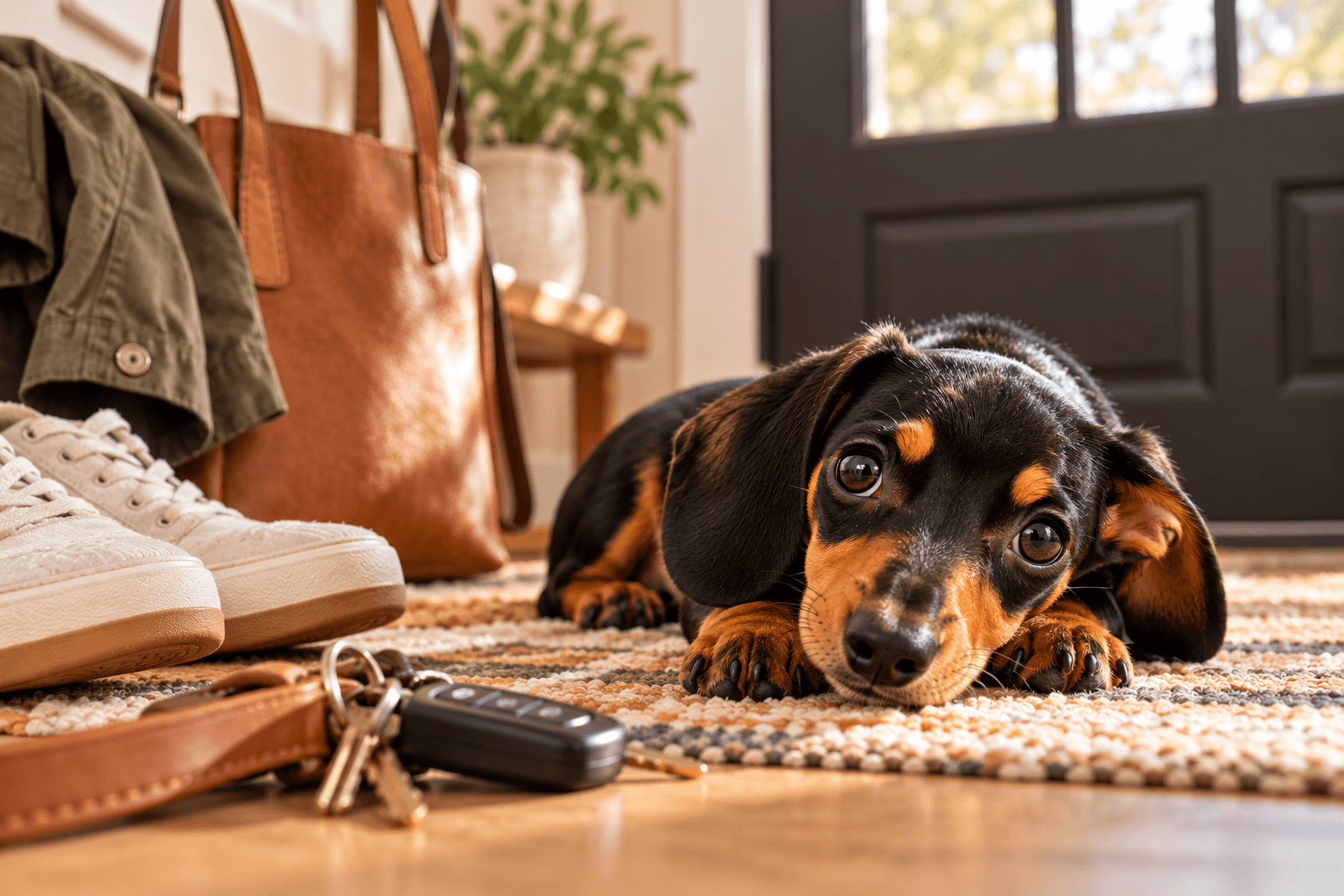
Watch for the “I'm Leaving” Triggers
Dogs are ridiculously good at learning routines.
You put on your work shoes.
Pick up your purse.
Grab your keys.
Put on your coat.
And suddenly there's a dachshund staring at you like:
Excuse me. Where exactly do you think you're going?
These cues can begin triggering anxiety before you've even reached the door.
For dogs who react strongly to departure cues, occasionally practice them without leaving.
Pick up your keys and put them back down.
Put your shoes on and make coffee.
Grab your bag and sit on the couch.
Over time, those actions can become less reliable predictors that you're about to disappear.

Give Them Something Appropriate to Do
Mental enrichment can be helpful for dogs who are comfortable enough to engage with it.
Depending on your dachshund, you might try:
A food puzzle
A stuffed food toy
A lick mat
A safe long-lasting chew
A snuffle-style activity
The goal isn't to distract a severely anxious dog into forgetting you've left.
For mild cases or dogs who simply need help settling, however, an appropriate activity can create a positive routine around alone time.
There's also an important clue here:
If your dachshund normally considers food the greatest invention in history but won't touch a favorite treat when you're gone, that can suggest they're too distressed to eat.
In that situation, simply buying a better puzzle toy probably isn't the whole answer.
Exercise Helps—but You Can't Out-Walk Anxiety
A dachshund who has had appropriate physical activity and mental stimulation may find it easier to settle.
A sniff-heavy walk before you leave can be particularly useful because sniffing provides mental stimulation as well as physical activity.
But exercise isn't a cure for separation anxiety.
You don't need to exhaust your dachshund until they can't protest your departure.
Think of exercise and enrichment as pieces of an overall routine—not a treatment for fear.
Should You Crate a Dachshund With Separation Anxiety?
It depends on the dog.
For a dachshund who already views the crate as a safe, comfortable place, it may provide a familiar environment for short periods alone.
For a dog who panics when confined, a crate can make the situation worse. Our puppy, Pete, eats in his kennel and is perfectly calm there—but when he realizes his people are getting ready to leave, he panics in his kennel.
A distressed dog may frantically scratch, bite or throw themselves against the crate trying to escape, creating a risk of injury. Pete even escaped his kennel once during one of these episodes and destroyed the carpet and damaged a door as he continued trying to find a way out.
So don't assume:
Separation anxiety = put them in a crate.
Pay attention to how your individual dachshund behaves.
Some dogs settle better in a crate. Others do better in a puppy-proofed room or another safe, limited area. For Pete, we puppy-proofed the living room and tried leaving him there for a few short practice runs. Once we saw that he was comfortable with the setup, we eventually left him there during a full work shift.
Our camera showed him content and napping for much of the day in his dog bed in front of the couch. What a difference that simple change made for his anxiety!
The safest setup is the one in which your dog can actually relax.
Don't Punish What Happened While You Were Gone
You come home.
The trash has been explored.
A pillow has met an unfortunate end.
There's a potty accident on the floor.
And your dachshund gives you that look.
It can certainly look like guilt.
But punishing your dog after the fact doesn't teach them what they should have done differently while you were gone.
If the behavior was driven by anxiety, punishment can add another layer of stress to an already difficult situation.
Instead, figure out why the behavior happened.
Was your dachshund anxious?
Bored?
Given too much freedom too soon?
Left longer than they're currently able to handle?
Did a puppy simply need a potty break?
Solving the cause is much more useful than punishing the evidence.
What About Getting Another Dachshund?
Ah yes.
The classic dachshund solution:
Perhaps this dachshund needs another dachshund.
And sometimes dogs genuinely enjoy having canine companionship.
But another dog isn't a reliable treatment for separation anxiety.
If your dachshund's anxiety is specifically about separation from you, having another dog in the house may not solve it.
You could simply end up with two dachshunds waiting at the window for you.
Which may be adorable.
But it's considerably more expensive.
Get another dachshund because you genuinely want another dog—not because you're counting on a second dog to fix the first one's anxiety.
When Separation Anxiety Needs Professional Help
Mild difficulty being alone can often improve with gradual training and a predictable routine.
More severe separation anxiety deserves professional help.
Talk with your veterinarian if your dachshund:
Panics when left alone
Attempts to escape and could injure themselves
Remains distressed for extended periods
Cannot eat or settle while you're away
Has suddenly developed separation-related behavior
Isn't improving despite careful training
Your veterinarian can also help rule out medical issues that might contribute to behavioral changes.
For significant anxiety, they may recommend working with a qualified behavior professional. In some cases, medication may also be part of a veterinarian-directed treatment plan alongside behavior modification.
That's very different from simply having a dachshund who complains when you leave and then curls up for a nap.
What If My Dachshund Suddenly Develops Separation Anxiety?
A sudden behavior change deserves attention—particularly in an adult or senior dog who previously handled being alone well.
Changes in routine can certainly play a role.
Moving.
A family member leaving the household.
A change in work schedule.
Spending an extended period together and then suddenly returning to long workdays.
But pain, illness, changes in hearing or vision, and age-related changes can also affect behavior.
If the change seems sudden or unexplained, it's worth discussing with your veterinarian rather than assuming your dachshund has simply become clingier.
A Simple Dachshund Alone-Time Routine
For a dachshund who's learning to be comfortable alone, keep the process simple:
Potty → appropriate exercise or sniffing → calm settling time → safe enrichment → short absence → calm return.
Then repeat.
Increase the time gradually as your dachshund shows you they're ready.
You're not trying to teach your dog that they shouldn't care when you leave.
You're teaching them something much more useful:
I can be okay when my person isn't here. And my person comes back.
Your Velcro Dachshund Can Still Learn Independence
One of the best things about dachshunds is how deeply they can attach to their people.
You don't need to change that.
The goal isn't to turn your little shadow into a dog who couldn't care less whether you're home.
It's to help them develop enough confidence and independence that being apart doesn't feel frightening.
Start small.
Keep departures predictable.
Give them opportunities to practice being alone successfully.
Pay attention to what your individual dog is telling you.
And if their distress is significant, get professional help rather than trying to force them through it.
Because ultimately, the goal isn't a dachshund who stops loving being with you.
It's a dachshund who knows they'll be okay until you come back.
And yes—they will probably still follow you into the bathroom the second you get home.