Best Ramps for Dachshunds: What to Look For Before You Buy
This post may contain affiliate links. If you purchase through one of these links, Doxie Life Guide may earn a small commission at no additional cost to you. I only recommend products I believe may be useful to dachshund owners.
If you share your home with a dachshund, you’ve probably watched those tiny legs launch a surprisingly long body off the sofa more times than you’d like.
Dachshunds aren’t exactly known for thinking, Maybe I should be careful with my back.
That’s where a good dog ramp can help.
A ramp gives your dachshund another way to get onto and off furniture, beds, and sometimes into vehicles without repeatedly jumping from an elevated surface.
But not every dog ramp is a good dachshund ramp. Some are too steep. Some are slippery. Some wobble. And some take up half the room while your dachshund confidently jumps off the sofa right beside them.
Before you buy one, here’s what I’d look for—and how to choose a ramp your dachshund will actually use.
Why Consider a Ramp for Your Dachshund?
Dachshunds are predisposed to intervertebral disc disease, commonly called IVDD, because of their genetics and body structure.
That doesn’t mean every dachshund will develop IVDD, and buying a ramp can’t guarantee that yours won’t.
What a ramp can do is provide a lower-impact alternative to repeatedly jumping on and off elevated surfaces.
For me, that’s enough reason to make ramps part of a dachshund-friendly home.
They can be particularly useful for:
Sofas and chairs
Beds
Vehicles
Porches or other raised areas
Senior dachshunds
Dogs with mobility limitations
Stairs
The trick is choosing the right one.
1. Look for a Gentle Incline
This may be the most important thing owners overlook.
A short ramp isn’t necessarily a better ramp.
If the ramp has to reach a fairly high bed or sofa but isn’t very long, the resulting incline can be surprisingly steep. Your dachshund may struggle to climb it—or simply decide jumping is easier.
A longer ramp generally creates a gentler slope.
Before ordering, measure the height of the furniture the ramp needs to reach and look at the ramp’s length and recommended setup.
Don’t shop based only on whether the product description says “for beds” or “for couches.” Your bed may be considerably higher than someone else’s.
Doxie Life Tip: Measure first. It’s much easier than discovering that your adorable new dachshund ramp has turned into a ski slope.
2. Traction Matters—A Lot
Imagine walking down a hill wearing socks on a hardwood floor.
That’s essentially what you’re asking your dachshund to do if the ramp surface is too slick.
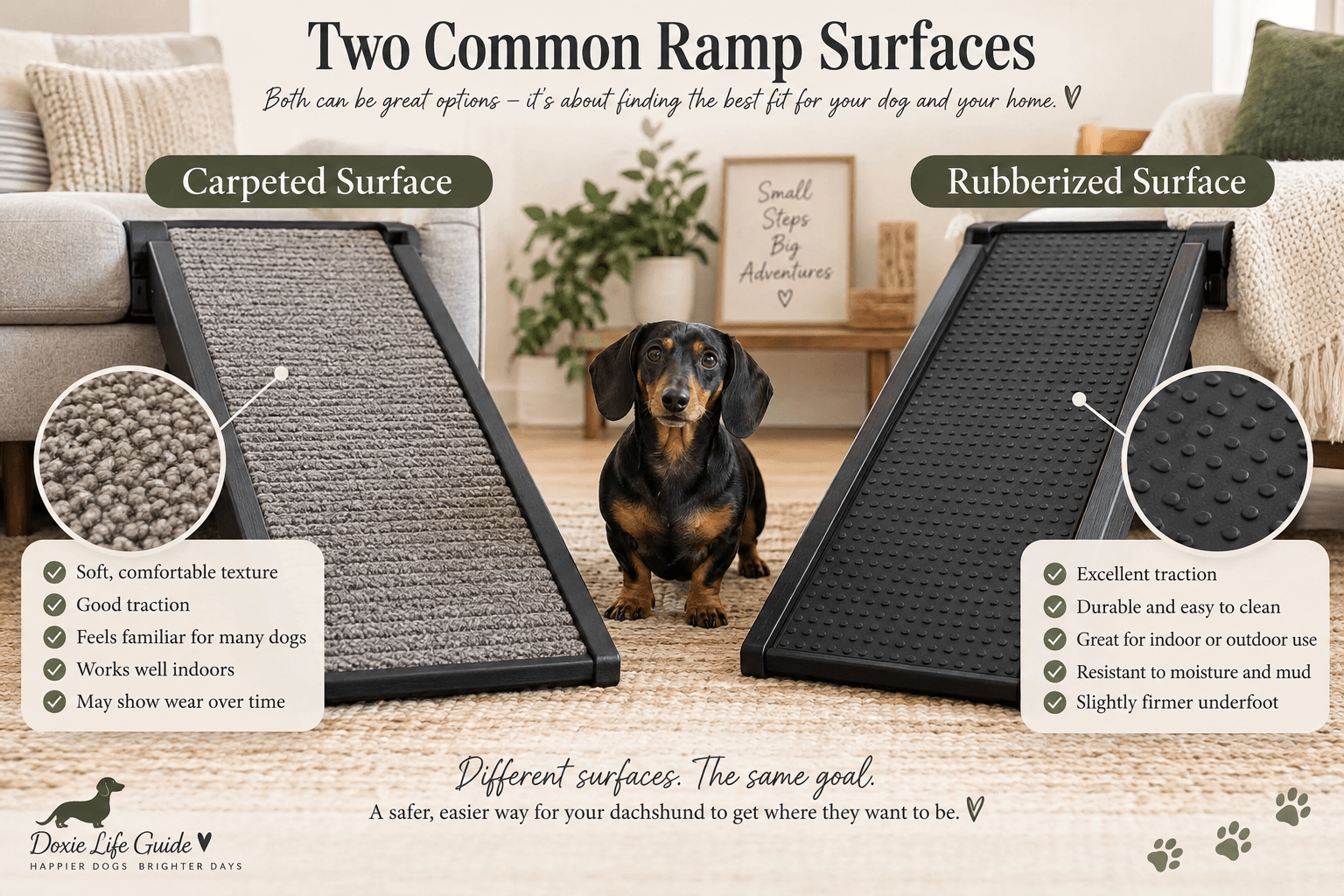
Look for a surface that gives those little paws something to grip.
Good options can include:
Textured carpeting
Rubberized surfaces
High-grip fabric
Other non-slip materials designed for pets
Traction becomes especially important when your dachshund is walking down the ramp.
A beautiful wooden ramp may match your furniture perfectly, but if the walking surface is slick, I’d keep shopping.
3. The Ramp Should Feel Rock Solid
Some dachshunds will march across anything without a second thought.
Others will place one paw on a ramp, feel the slightest wobble, and immediately decide:
Absolutely not.
A ramp should sit securely against the furniture and remain stable while your dog walks across it.
Check:
Weight capacity
How the ramp attaches or rests against furniture
Whether the base has non-slip feet
Whether adjustable sections lock securely
Reviews mentioning wobbling or movement
This is one area where I’d prioritize construction over appearance.
A ramp only works if your dog trusts it enough to use it.
4. Consider the Width and Side Rails
Remember that your dachshund won’t necessarily walk perfectly down the center of a ramp every time.
A wider walking surface can give your dog more room to maneuver and may help them feel more confident.
Side rails or raised edges are another feature I particularly like for elevated ramps. They can help define the walking path and provide a little extra security, especially for puppies, seniors, or dogs that aren’t particularly graceful.
And yes, dachshunds can be remarkably athletic and somehow still not particularly graceful.
5. Think About Where You’ll Actually Put It
Here’s the less exciting part of shopping for a dog ramp:
Where is this thing going to live?
A nice gradual incline requires length, and length requires floor space.
Before buying, use a tape measure to see how far the ramp will extend into your room.
Think about traffic patterns too. You don’t want to protect your dachshund from jumping only to create something every human in the house trips over.
For tight spaces, an adjustable ramp or carefully chosen alternative may work better than simply buying the longest ramp you can find.
Ramp vs. Dog Stairs: Which Is Better for a Dachshund?
You’ll find both ramps and pet stairs marketed to dachshund owners.
Personally, for getting on and off higher furniture, I’d generally look at a ramp first.
A ramp creates a continuous walking surface rather than requiring a short-legged dog to negotiate individual steps. Veterinary sources also commonly recommend ramps or stairs as alternatives for dogs predisposed to back problems, with ramps offering low-impact access to elevated surfaces.
That doesn’t mean pet stairs are automatically bad for every dachshund. Your dog’s age, health, mobility, furniture height, and home setup all matter.
If your dachshund has already been diagnosed with IVDD, has had surgery, is experiencing pain, or has mobility problems, this isn’t something I’d decide based on an internet product guide. Ask your veterinarian or rehabilitation professional what type of setup is appropriate for your dog.
What I Look For in a Dachshund Ramp
If I were comparing two ramps side by side, these would be my priorities:
1. Gentle incline
Long enough for the height I’m trying to reach.
2. Excellent traction
Especially for walking down.
3. Stability
No wobbling, sliding, or shifting.
4. Appropriate width
Enough room for comfortable movement.
5. Side protection
Rails or raised edges when appropriate.
6. Weight capacity
Well above my dog’s weight.
7. Practical size
It actually fits where I intend to use it.
8. Easy cleaning
Because dogs.
I’d choose those features before worrying about whether the ramp perfectly matches my living-room furniture.
What I Use With My Dachshunds
My dogs sleep with me. My bed is their bed and they are in and out of it all day long! I use a long, adjustable ramp that runs parallel to the footboard of my bed. It’s 5 feet long, so the incline is not too steep for them to use comfortably. In my living room, I have a similar adjustable ramp that is 30 inches long. Since the couch is not nearly as high as my bed, the ramp can be shorter. Both have a textured carpet covering so the dogs don’t slip. In my daughter’s room, space was an issue and a long ramp wasn’t realistic for bed access. In that room, we have a set of gentle, foam steps up to the bed. So just know that there isn’t a “1 right ramp”! The most important thing is finding options that your doxies will use and your family can incorporate into your home.
[Future Affiliate link-Bed ramps, couch ramps, car ramps and other dachshund-friendly mobility products].
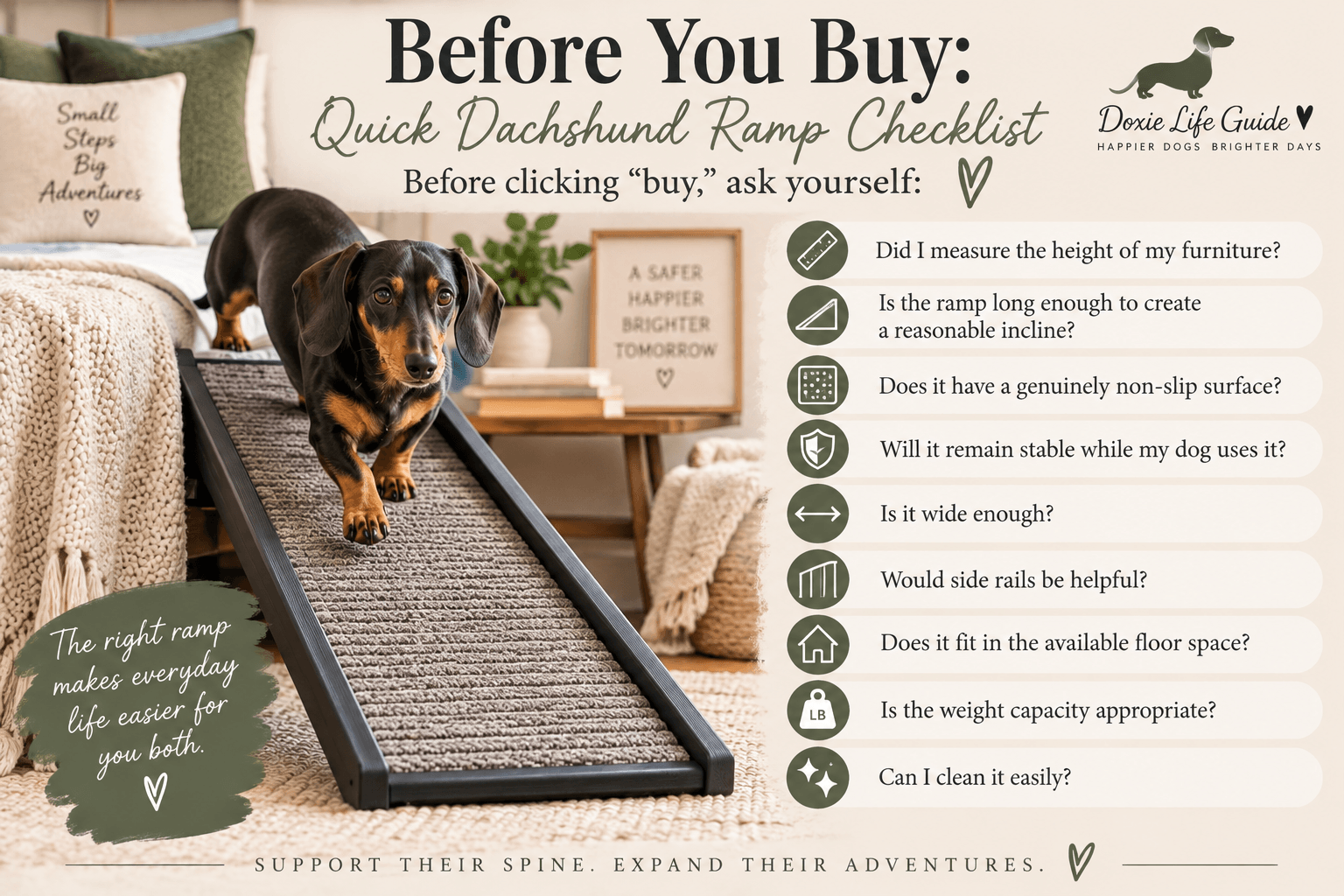
Before You Buy: Quick Dachshund Ramp Checklist
Before clicking “buy,” ask yourself:
Did I measure the height of my furniture?
Is the ramp long enough to create a reasonable incline?
Does it have a genuinely non-slip surface?
Will it remain stable while my dog uses it?
Is it wide enough?
Would side rails be helpful?
Does it fit in the available floor space?
Is the weight capacity appropriate?
Can I clean it easily?
Am I willing to spend a little time teaching my dachshund to use it?
If the answer to all of those is yes, you’re probably looking at a much better candidate than simply choosing whichever ramp has the cutest product photo.
The Bottom Line
A dachshund ramp doesn’t need to be fancy.
It needs to be stable, grippy, appropriately sized, and comfortable for your dog to use.
And remember that a ramp is just one part of caring for a dachshund’s back. Maintaining a healthy weight, providing appropriate exercise, handling your dog carefully, and talking with your veterinarian about your individual dog’s needs all matter too.
Most importantly, don’t wait until your dachshund is older to introduce one if you already know you want ramps in your home.
A young dog can learn that the ramp is simply how we get onto the couch.
Because changing a dachshund’s mind after they’ve spent eight years doing something their own way?
That’s a whole different blog post.
Affiliate Disclosure
This post may contain affiliate links. If you purchase through one of these links, Doxie Life Guide may earn a small commission at no additional cost to you. I only recommend products I believe may be useful to dachshund owners.
Important Note
This article is for general educational purposes and isn’t a substitute for professional veterinary advice. If your dachshund has back pain, mobility problems, IVDD, or is recovering from an injury or surgery, consult your veterinarian before changing their activity or mobility setup.