How to Train a Dachshund to Use a Dog Door
They may be fearless enough to bark at a delivery truck—but somehow a little flap in the door can stop a dachshund in their tracks.
My son recently moved into a house that already had a dog door installed. Perfect, right?
Except his two dachshunds that moved in with him had absolutely zero clue what they were supposed to do with it.
To us, a dog door seems obvious: push the flap, walk through, go outside. To a dog who has never seen one before, it can be a strange little opening with a flap that moves, makes noise, touches their back and then swings shut behind them.
So if your dachshund stares at the dog door like you've installed a portal to another dimension, don't worry. Most dogs can learn to use one—you just may need to show them how.
Why Won't My Dachshund Use the Dog Door?
Using a dog door isn't necessarily instinctive. The moving flap is unfamiliar, and some dogs are uncomfortable pushing their head into something they can't clearly see through.
That hesitation doesn't mean your dachshund is being stubborn.
The American Kennel Club recommends introducing a dog door gradually and creating positive associations with it rather than pushing a dog through or punishing them for refusing. American Kennel Club
And with dachshunds, taking things one small step at a time can be especially useful. Training professionals use a method called shaping, where you reward little pieces of progress instead of waiting for the dog to perform the entire behavior. It's specifically useful for things like teaching a hesitant dog to use a dog door. PetMD
First: Make Sure the Dog Door Is Safe for Your Dachshund
Before training, check the actual door.
Your dachshund shouldn't have to squeeze through a tiny opening, scrape their back against the top, or make an awkward jump to get through it. A dog door that's too small can make a dog even more reluctant to use it and may be unsafe. American Kennel Club
For a dachshund, I'd also pay attention to the height of the threshold. We spend so much time trying to reduce unnecessary jumping for these long-backed little dogs that it doesn't make sense to teach them to launch themselves through a dog door that's positioned awkwardly high.
You want easy in, easy out.
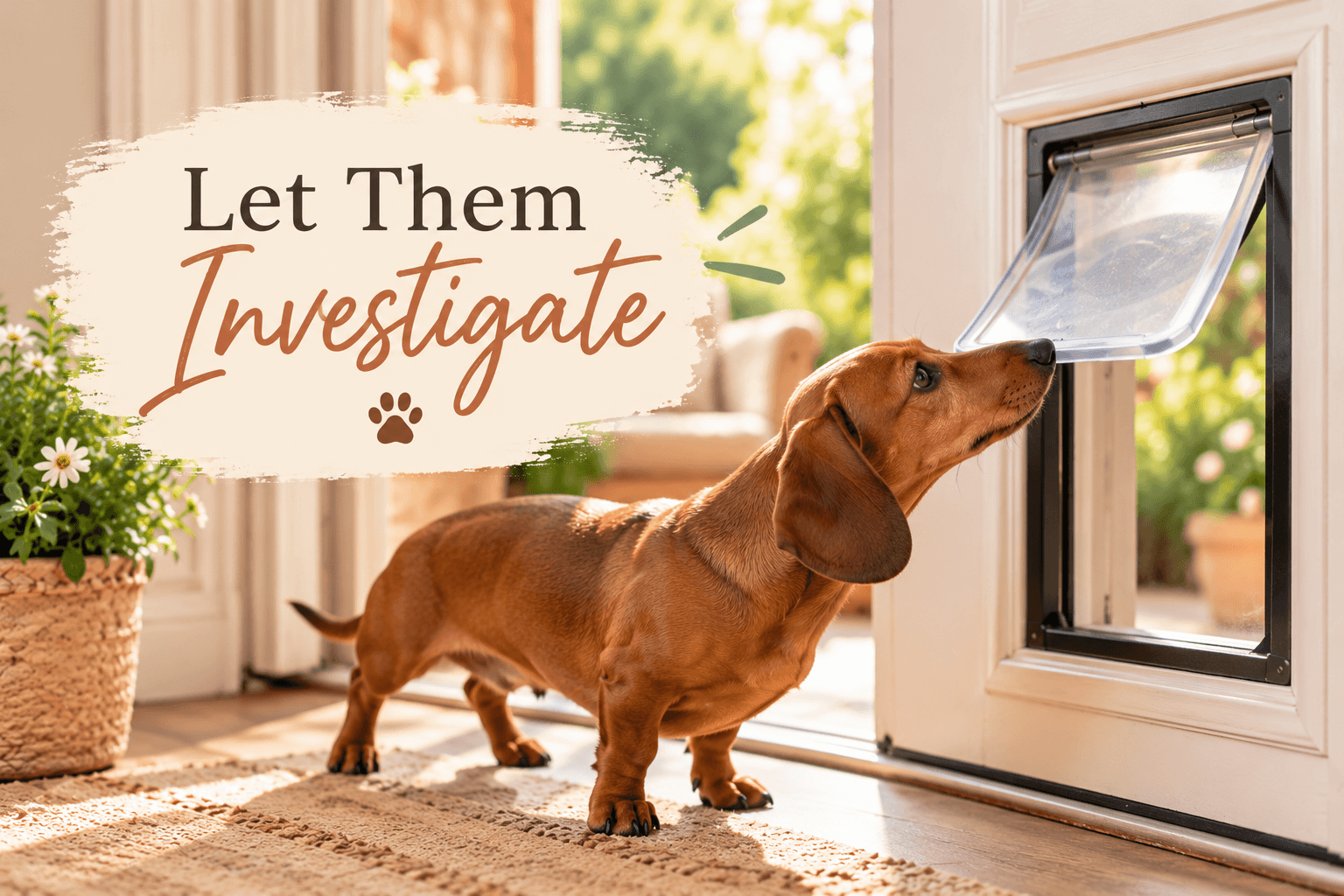
Step 1: Let Them Investigate It
Don't start by trying to get your dachshund all the way through.
Start with something much easier.
Walk over to the dog door with a few really good treats. Let your dog sniff it. Move the flap gently with your hand. Let them hear the sound it makes.
Reward curiosity.
Sniff the flap? Treat.
Touch it with a nose? Treat.
Paw at it? Treat.
Stick a nose through the opening? Definitely treat.
You're teaching one very simple lesson:
This weird little door is safe—and good things happen around it.
Step 2: Hold the Flap Completely Open
This is the step my son started with for my his dogs.
Hold or secure the flap all the way open so the dog can clearly see through to the other side.
Have one person stay with the dog while another person goes to the opposite side with treats.
Then call the dog through.
Don't pull them. Don't shove them from behind. And don't repeatedly push their head toward the opening.
Make the other side worth investigating.
Use a favorite treat, happy praise or even a favorite toy.
PetSafe recommends beginning with the flap fully open and calling the dog through from the opposite side. Short practice sessions are preferable to pushing until everyone gets frustrated. PetSafe
A Two-Person Trick
If you have two people available, use them.
One person sits inside.
One person sits outside.
Call your dachshund back and forth through the open dog door, rewarding them every time.
Outside → treat.
Inside → treat.
Outside → treat.
Inside → treat.
Now you're not just teaching them how to exit the house. You're teaching the equally important part:
how to get back in.
Step 3: Lower the Flap Just a Little
Once your dachshund is happily trotting through the open doorway, don't immediately drop the flap and expect them to figure out the rest.
Lower it slightly.
Now your dog may feel it brush the top of their head or back as they pass underneath.
Reward them generously when they come through.
After several successful trips, lower it a little more.
Then a little more.
Eventually, your dachshund learns that pushing against the flap makes it move.
That's the breakthrough we're looking for.
AKC recommends this same gradual progression—starting with an open flap, then holding it partially open and progressively lowering it as the dog becomes more confident. American Kennel Club
Step 4: Let Your Dachshund Push the Flap
Eventually, stop doing all the work for them.
Leave the flap almost closed and encourage your dachshund from the other side.
They may nose it.
They may paw it.
They may stare at you like you've lost your mind.
Give them a moment to figure it out.
The instant they push the flap and come through:
Celebrate and reward.
That little nose push is the behavior you want them to discover.
Once they understand:
Push flap → door opens → I can go through
the whole thing usually starts making much more sense.
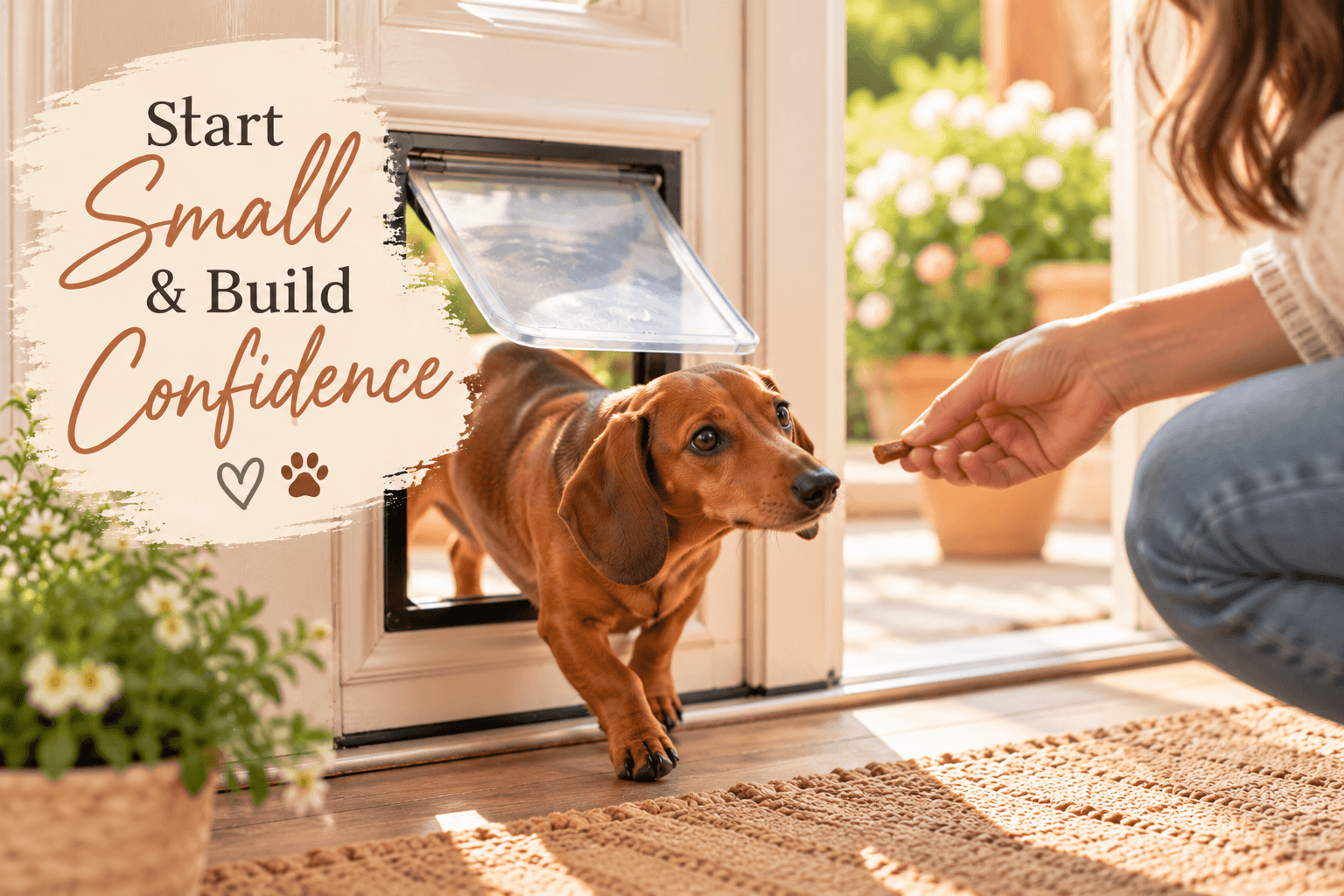
What If My Dachshund Is Afraid of the Dog Door?
Back up a step.
If your dachshund won't approach the opening, don't keep luring them closer until they're uncomfortable. Instead, reward much smaller steps: looking at the door, approaching it, sniffing it and eventually touching it.
That's shaping.
The goal isn't to see how quickly you can get your dog through the door. The goal is to build enough confidence that they choose to go through it themselves. PetMD
Some dachshunds may figure the whole thing out in one afternoon.
Others may need several short sessions.
Both are fine.
What NOT to Do
The biggest mistake is physically pushing your dachshund through the dog door.
It may technically get the dog to the other side—but it doesn't teach them that the door is safe.
In fact, forcing a nervous dog through can create an even stronger negative association with the flap. Both AKC and PetSafe specifically recommend against pushing or forcing a dog through. American Kennel Club
Keep training upbeat and short. If your dachshund becomes worried or frustrated, stop and try again later.
Use Really Good Rewards at First
This is not the time for a boring piece of kibble if your dachshund doesn't care about kibble.
Use tiny pieces of a high-value treat they love.
You're paying well for a brand-new skill.
Once your dachshund is confidently using the door, you won't need to hand over a treat every time they walk through it. Going outside to sniff the yard, explore or go potty eventually becomes its own reward.
Train Both Dachshunds Separately at First
If you have more than one dog, I'd actually teach each dog individually at first.
One dachshund may be bold and figure it out immediately while the other hangs back. Working separately lets you see exactly what each dog is comfortable with and keeps the more confident dog from doing all the thinking.
Once both understand the basic idea, practicing together can be helpful.
And there's a decent chance that once one dachshund confidently pops through that mysterious little flap, the other will decide:
Well, if SHE can do it…
Don't Give Them Unsupervised Access Yet
Knowing how to go out isn't enough.
Before relying on the dog door, make sure your dachshund confidently uses it in both directions with the flap completely down.
You don't want a dog happily wandering outside and then panicking because they haven't learned how to push their way back inside.
AKC recommends making sure dogs are completely comfortable going back and forth before they're left to use a dog door independently. American Kennel Club
And remember: a dog door is only as safe as the area it leads to.
It should open into a securely fenced or otherwise safely enclosed area, and dogs shouldn't automatically be given unlimited outdoor access just because a dog door exists. Weather, wildlife, escape risks and what's happening in the yard all matter. American Kennel Club
How Long Does It Take to Teach a Dachshund to Use a Dog Door?
There's no magic number.
A confident, food-motivated dachshund might understand the concept surprisingly quickly. A cautious dog may need several days of short practice sessions before they're comfortable pushing through the flap.
PetSafe suggests brief sessions rather than trying to accomplish too much at once; their guidance uses two spaced-out sessions of about 10 minutes as an example. PetSafe
The important part isn't speed.
It's confidence.
The Dachshund Dog Door Training Plan
If you want the whole process boiled down, it's this:
Introduce the door — reward sniffing, touching and investigating.
Hold the flap completely open — reward going through in both directions.
Lower the flap slightly — let it begin touching your dachshund as they pass.
Lower it gradually — require your dog to push a little more each time.
Let the flap close — reward your dachshund for pushing through independently.
Practice both directions — don't assume knowing “out” means knowing “in.”
Keep supervising until you're confident your dachshund can safely use it alone.
A Little Patience Goes a Long Way
A dog door can eventually give your dachshund more independence and make potty trips much more convenient.
But first, somebody has to explain what the thing is.
So if your dachshund is currently standing three feet away staring suspiciously at the flap, don't assume they're never going to use it.
Open it.
Grab the good treats.
Celebrate the tiny victories.
And give that stubborn little brain a chance to figure it out.
Because once a dachshund realizes that little door leads directly to the backyard whenever they want it, you may have an entirely different problem:
Getting them to come back inside. ❤️