Dachshund Back Care: Everyday Ways to Help Protect Their Spine
This post may contain affiliate links. If you purchase through one of these links, Doxie Life Guide may earn a small commission at no additional cost to you. I only recommend products I believe may be useful to dachshund owners.
Those adorable short legs and long bodies are a huge part of what makes dachshunds so lovable.
They’re also the reason dachshund owners need to pay a little extra attention to back health.
Dachshunds are predisposed to intervertebral disc disease (IVDD), a condition involving the discs between the vertebrae of the spine. You can’t completely eliminate the risk of IVDD, and even dachshunds whose owners do everything “right” can develop back problems.
But there are practical things you can do every day to help reduce unnecessary strain, keep your dachshund strong and fit, and make their environment a little more back-friendly.
Here are some good habits to start.
1. Keep Your Dachshund at a Healthy Weight
Maintaining a healthy body condition is one of the most important things you can do for your dachshund’s overall health.
Even a few extra pounds can be significant on such a small dog.
Extra weight means your dachshund has more weight to carry during every walk, stair climb and trip across the house. Keeping your doxie lean also makes it easier for them to remain active and maintain good muscle condition.
If you’re not sure whether your dachshund is at a healthy weight, ask your veterinarian to assess their body condition rather than relying only on a number on the scale.
And yes, those dachshund eyes can make portion control difficult.
Stay strong.
2. Reduce Unnecessary Jumping
If you’ve ever lived with a dachshund, you know they don’t necessarily see themselves as short-legged dogs.
Couch? Jump.
Bed? Jump.
Car seat? Jump.
They can be surprisingly athletic.
You don’t necessarily need to spend your entire day following your dachshund around shouting, “DON’T JUMP!” But reducing repeated jumping from higher surfaces is a reasonable way to make your home more back-friendly.
Consider using ramps for places your dachshund frequently gets on and off, such as:
The couch
Your bed
A favorite chair
Your vehicle
The important part is teaching your dachshund to actually use the ramp instead of placing one beside the couch and hoping for the best.
If you’ve already purchased a ramp and your dachshund is avoiding it, see our How to Train a Dachshund to Use a Ramp guide for a simple step-by-step approach.
3. Choose Ramps With Good Traction and a Gentle Incline
A ramp isn’t automatically better just because it’s a ramp.
A steep or slippery ramp can be difficult for a short-legged dog to navigate. Look for a stable ramp with good traction and an incline your dachshund can comfortably manage.
Width matters too. Your dog should have enough room to walk naturally without feeling like they’re balancing on a narrow board.
If you’re shopping for one, our Best Ramps for Dachshunds: What to Look For Before You Buy guide explains the features that can make a ramp easier and safer for a doxie to use.
4. Don’t Avoid Exercise
Protecting your dachshund’s back doesn’t mean wrapping them in bubble wrap.
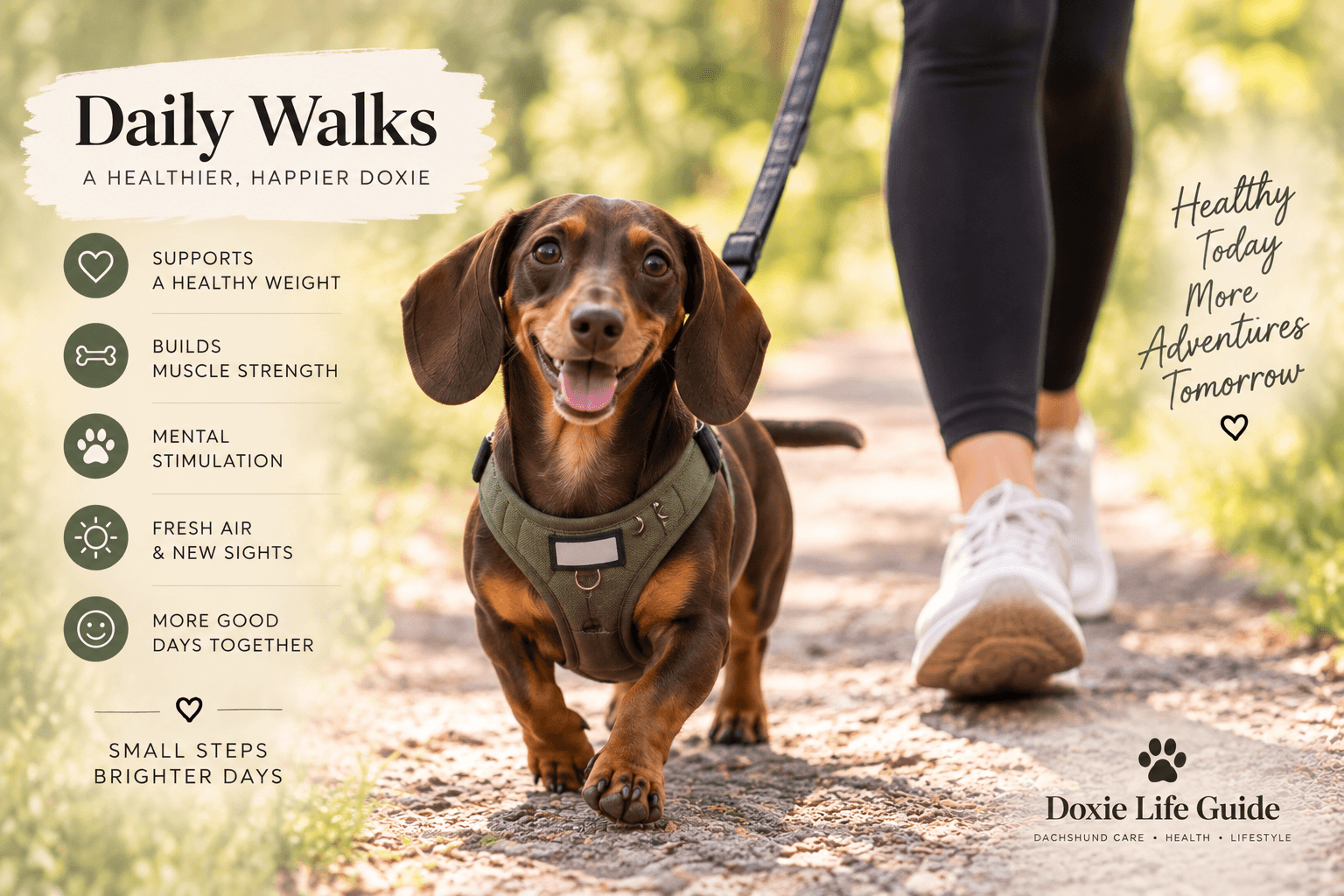
Regular, appropriate exercise helps maintain muscle strength, supports a healthy weight and provides important mental stimulation.
Walking is a great activity for many dachshunds.
Instead of relying only on occasional bursts of intense activity, aim for regular exercise that fits your dog’s age, fitness level and health.
The appropriate amount will vary from dog to dog. A young, active dachshund may happily walk much farther than an older dog with mobility issues.
If your dachshund has previously experienced IVDD or another orthopedic or neurological condition, ask your veterinarian what type and amount of exercise is appropriate.
5. Watch Out for Slippery Floors
Hardwood, laminate and tile floors can turn into skating rinks for little dachshund feet.
If your dog regularly slips while running through the house, consider adding traction in the areas they use most.
Area rugs, runners and non-slip mats can give your dachshund better footing, especially:
Near couches and beds
At the bottom of ramps
In hallways where they like to run
Near food and water bowls
Around doors where excitement tends to take over
Keeping nails appropriately trimmed and the fur between the paw pads under control can also help your dachshund maintain better traction.
6. Use a Well-Fitting Harness
A properly fitted harness can be a good choice for walking a dachshund because it distributes leash pressure across the body rather than concentrating it at the neck.
Fit is especially important with dachshunds because of their unusual proportions.
Their deep chest, long torso and shorter legs mean a harness designed for an average-shaped dog may not fit quite right.
A good harness should allow comfortable movement without rubbing behind the front legs, restricting the shoulders or allowing your dachshund to back out of it.
We’ll be covering how to choose a properly fitting harness for a dachshund in a separate Doxie Life Guide article.
7. Learn How to Pick Up Your Dachshund Properly
There will be plenty of times when your dachshund needs to be picked up.
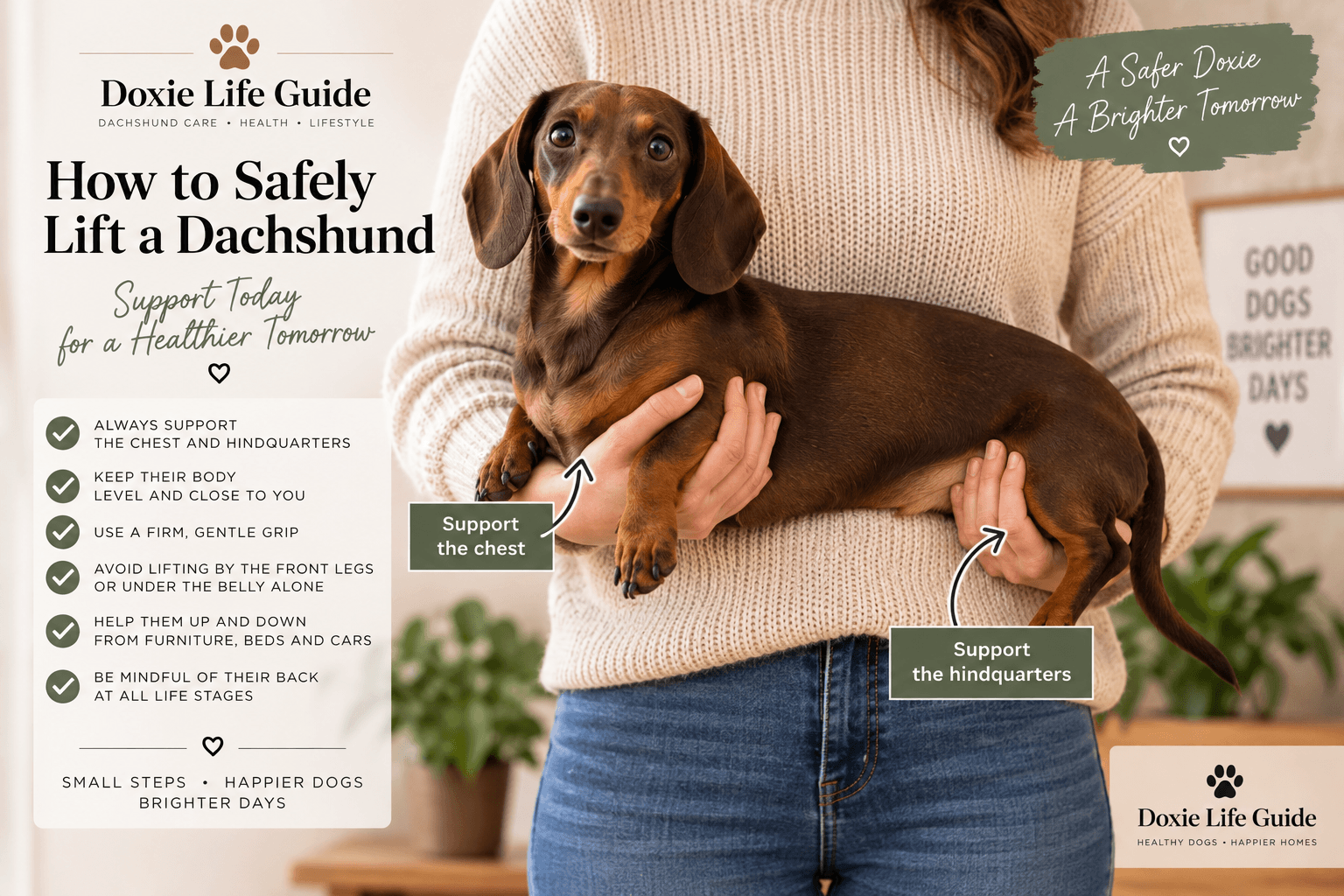
When lifting them, support both the front and back of their body rather than allowing the rear half to dangle.
One hand or arm can support the chest while the other supports the hindquarters, keeping the body reasonably level and supported.
It’s also important to teach children and visitors how to pick up your dachshund correctly.
And if your dachshund is experiencing back pain or you suspect an injury, avoid unnecessary handling and contact your veterinarian for guidance.
8. Be Thoughtful About Stairs
Stairs are a more complicated topic than simply declaring that every dachshund should never use them.
Age, fitness, health, stair design and your individual dog’s abilities all matter.
A few carpeted steps are very different from repeatedly racing up and down a long, slippery staircase.
If you have a full staircase in your home and don’t want your dachshund using it unsupervised, a pet gate can be a simple solution.
For dachshunds with a history of IVDD, mobility limitations or other medical concerns, ask your veterinarian what they recommend for your particular dog.
9. Keep Your Dachshund’s Environment Consistent
Sometimes it’s the little things that make a difference.
If your dachshund uses a ramp to reach the couch, keep it in the same place whenever possible.
If you’ve placed runners across a slippery floor, try not to leave large gaps where your dog has to jump from one grippy surface to another.
Think about the routes your dachshund travels every day.
Where do they jump?
Where do they slip?
Where do they scramble?
Where do they hesitate?
Looking at your house from the perspective of a dog only several inches off the ground can reveal things you might never have noticed.
10. Know the Signs That Something May Be Wrong
Even with thoughtful back care, dachshunds can still experience spinal problems.
Knowing what’s normal for your dog can help you recognize when something has changed.
Possible signs of back or neck pain or neurological problems can include:
Reluctance to walk, jump or move normally
Crying out or showing signs of pain
A tense or hunched posture
Shaking or trembling
Weakness or wobbliness in the legs
Dragging or knuckling a paw
Difficulty standing or walking
Loss of bladder or bowel control
Sudden paralysis
Some spinal problems can progress quickly.
If your dachshund suddenly becomes weak, has difficulty walking, drags their legs, loses bladder or bowel control, or appears to be in significant pain, contact a veterinarian promptly. Sudden loss of the ability to walk should be treated as an emergency.
You Can’t Eliminate Every Risk — and That’s Okay
It’s easy to become anxious about back problems when you own a dachshund.
But your dog still needs to be a dog.
They need exercise, play, exploration and all the normal things that make life fun.
The goal isn’t to create a perfectly controlled environment where your dachshund never makes an unexpected move. That’s probably impossible anyway — especially with a doxie.
Instead, focus on the things you can control:
Maintain a healthy weight. Provide regular appropriate exercise. Give them good traction. Reduce unnecessary high-impact jumping. Use supportive equipment when it makes sense. Learn the warning signs of a potential back problem.
Then enjoy your dachshund!
Because protecting their quality of life matters just as much as protecting their back.
Affiliate Disclosure
This post may contain affiliate links. If you purchase through one of these links, Doxie Life Guide may earn a small commission at no additional cost to you. I only recommend products I believe may be useful to dachshund owners.
Important Note
This article is for general educational purposes and isn’t a substitute for professional veterinary advice. If your dachshund has back pain, mobility problems, IVDD, or is recovering from an injury or surgery, consult your veterinarian before changing their activity or mobility setup.