How Much Should a Dachshund Eat? A Simple Guide to Portions, Calories & Healthy Weight
If you’ve ever stood over your dachshund’s food bowl wondering, “Is this actually enough food?” — you’re definitely not alone.
Dachshunds are small dogs with very convincing appetites. Some will happily finish dinner and then act as though they haven’t eaten in days.
But figuring out how much a dachshund should eat isn’t as simple as following the serving size printed on a bag of dog food.
A dachshund’s ideal portion depends on several things, including their weight, age, activity level, body condition, and the calorie content of their food.
And for dachshunds, maintaining a healthy weight is especially important. Extra pounds don’t just change how your dog looks — they also place additional stress on those short legs and that long spine.
Here’s a simple way to figure out whether your dachshund is getting the right amount of food.
How Much Should a Dachshund Eat Per Day?
There isn’t one perfect serving size for every dachshund.
A young, active 12-pound dachshund may need more calories than a quiet 16-pound senior. A growing puppy will have different nutritional needs than an adult dog, and a dachshund who needs to lose weight shouldn't automatically be fed the same amount as another dog of the same size.
That’s why it’s usually better to think in terms of daily calories and body condition rather than cups of food alone.
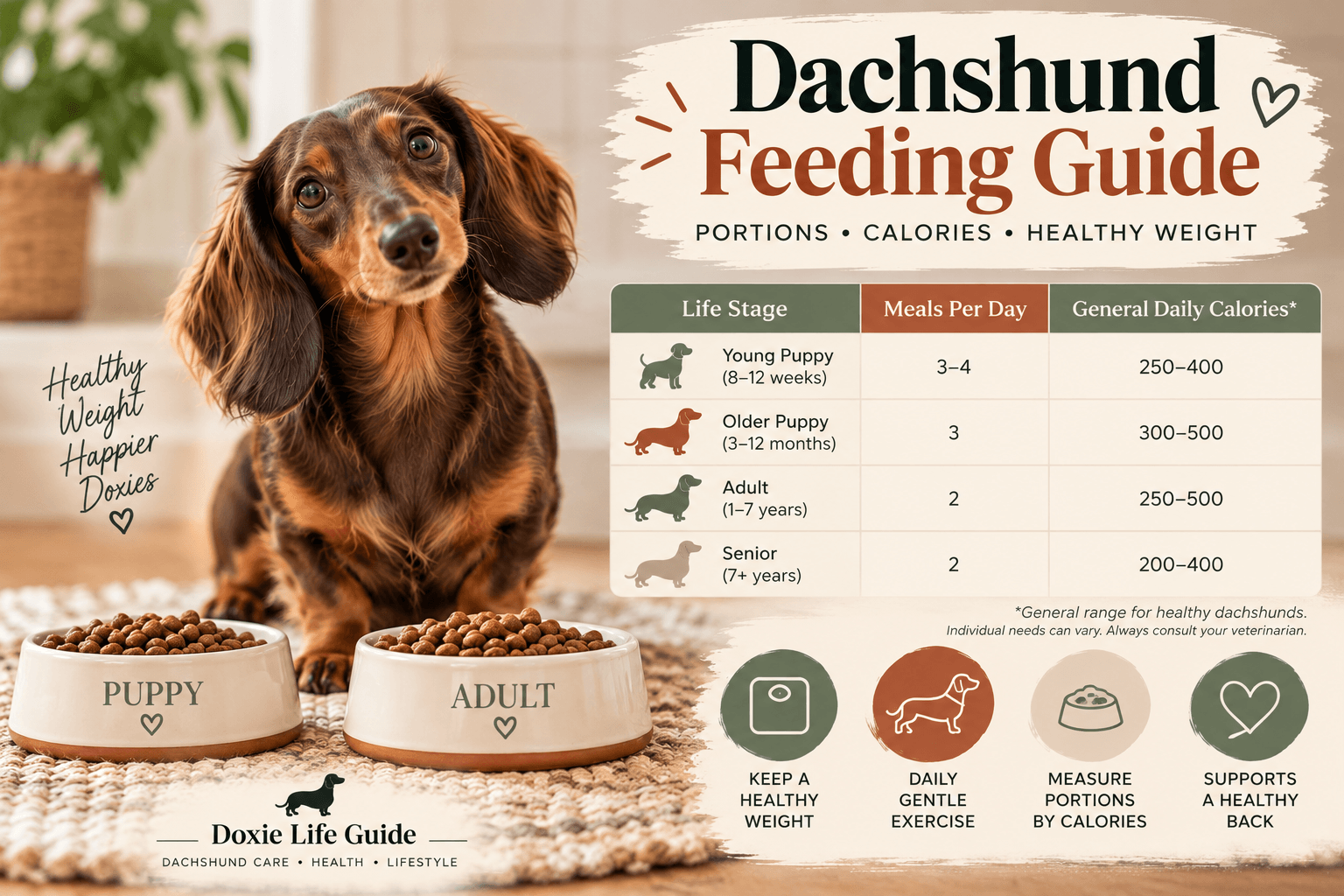
As a very general starting point, many healthy adult dachshunds may fall somewhere around 250–500 calories per day, but individual needs can vary considerably.
Miniature dachshunds may need less, while larger or highly active dachshunds may need more.
Your veterinarian can help determine an appropriate calorie target for your individual dog, particularly if your dachshund is overweight, underweight, very young, elderly, or has a medical condition.
Why “One Cup a Day” Doesn't Tell the Whole Story
One of the easiest feeding mistakes is measuring food only by volume.
Two dog foods can look almost identical in the bowl while containing very different numbers of calories.
For example, one kibble might contain:
320 calories per cup
while another contains:
450 calories per cup.
That means feeding one cup of each would provide dramatically different amounts of energy.
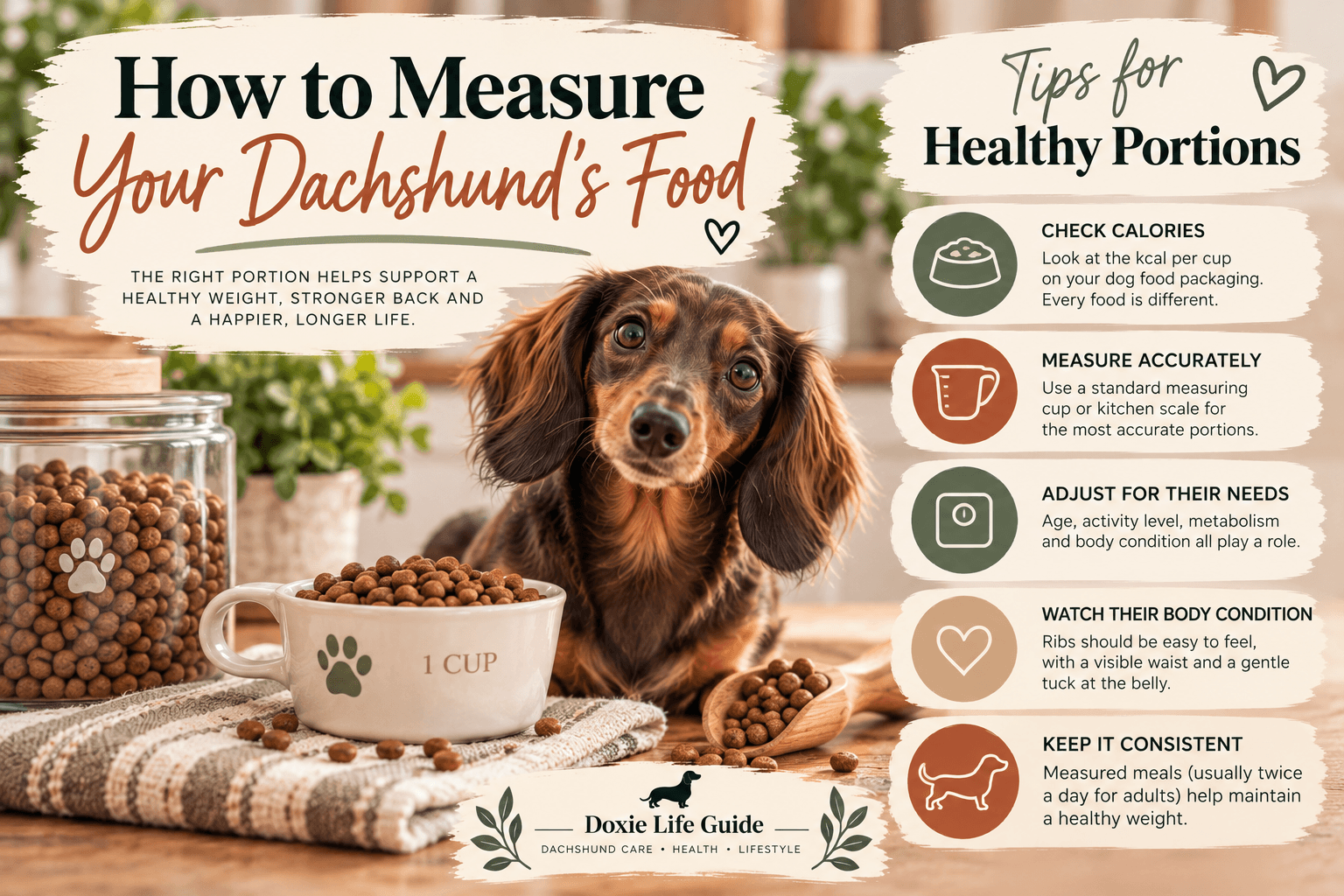
Look for the calorie information on your dog's food packaging. It may be listed as kcal per cup, kcal per can, or kcal per kilogram.
Once you know how many calories the food contains, you can determine a much more accurate portion.
A Simple Example
Suppose your dachshund's daily target is about 350 calories and their kibble contains 400 calories per cup.
350 ÷ 400 = 0.875 cups per day
That works out to roughly 7/8 cup per day, divided between meals.
The numbers will be different for every dog and every food, but this gives you a much better starting point than simply filling the bowl.
How Often Should You Feed a Dachshund?
For most healthy adult dachshunds, two measured meals per day works well.
Feeding breakfast and dinner can help control portions while preventing your dachshund from having access to unlimited food throughout the day.
Puppies generally need to eat more frequently because they have small stomachs and are still growing.
A typical schedule might look something like this:
Young puppies: 3–4 meals per day
Older puppies: about 3 meals per day
Healthy adults: usually 2 meals per day
Senior dachshunds: often 2 meals per day, although individual needs vary
Your veterinarian may recommend a different schedule depending on your dog's health or nutritional needs.
How Much Should a Dachshund Puppy Eat?
Puppies are one situation where you don't want to simply take an adult feeding recommendation and make the portion smaller.
Dachshund puppies need enough calories, protein, vitamins, minerals, and other nutrients to support growth and development.
Start with a complete and balanced puppy food appropriate for your puppy's life stage and use the manufacturer's feeding recommendations as a starting point.
Then watch your puppy rather than relying only on the chart.
Growth rate, activity and body condition matter.
Your veterinarian can also monitor your puppy's weight and body condition during routine puppy visits and help you adjust portions as they grow.
And remember: puppies grow quickly.
The amount that was appropriate several weeks ago may not be the right amount today.
What Is a Healthy Weight for a Dachshund?
The number on the scale only tells part of the story.
Dachshunds naturally vary in size, so two perfectly healthy dogs may weigh very different amounts.
Instead of trying to make your dachshund match a particular number, pay attention to their body condition.
At a healthy weight, you should generally be able to:
Feel the ribs easily beneath a thin layer of tissue without having to press hard.
See a waist when looking down at your dachshund from above.
See an abdominal tuck when looking at your dog from the side.
You shouldn't normally see sharply protruding ribs, hips or spine — but you also shouldn't have to dig through a thick layer of fat to find the ribs.
Your veterinarian can give your dachshund a Body Condition Score (BCS) and show you exactly what to look for at home.
Why Healthy Weight Matters So Much for Dachshunds
Weight management matters for every dog, but dachshunds deserve a little extra attention.
Their distinctive long-backed, short-legged build already puts unique demands on their bodies. Excess weight adds unnecessary load to their joints and spine and can make normal activities more difficult.
Keeping your dachshund lean is one of the practical things you can do to support their overall mobility and health.
That doesn't mean your dachshund needs to be extremely thin.
The goal is simply a healthy, lean body condition appropriate for that individual dog.
Don't Forget to Count Treats
This is where portions can get sneaky.
You carefully measure breakfast.
You carefully measure dinner.
Then your dachshund gets:
a training treat...
a little bite while you're cooking...
a dental chew...
a piece of cheese...
and another treat because they stared at you with those giant dachshund eyes.
Suddenly, the day's calorie intake looks very different.
Treats and extras should generally make up no more than about 10% of your dog's daily calories, with the majority of their nutrition coming from a complete and balanced diet.
For a small dog, that 10% can disappear surprisingly quickly.
Breaking treats into tiny pieces is an easy trick. Your dachshund usually cares much more about getting another treat than whether each treat is enormous.
Measure Meals Instead of Eyeballing Them
It's remarkably easy for portions to creep upward when you scoop food straight from the bag.
A measuring cup is better than guessing.
For even greater consistency, consider using an inexpensive digital kitchen scale and weighing your dog's food in grams.
This can be especially useful if you're trying to help an overweight dachshund gradually reach a healthier body condition.
Small differences don't look like much in a bowl, but for a 10-, 12- or 15-pound dog, those extra calories can add up.
What If My Dachshund Is Always Hungry?
First, remember an important fact about dachshunds:
Some are extraordinarily talented actors.
Finishing dinner and immediately staring at the food cabinet does not necessarily mean your dachshund needs more calories.
Before increasing their food, look at the bigger picture.
Is their weight stable?
Can you easily feel their ribs?
Do they have a visible waist?
Are they maintaining good energy?
If your dachshund is at a healthy weight and eating an appropriate complete diet, begging alone isn't necessarily a reason to increase portions.
You can also use part of their regular meal for enrichment. Try putting some kibble in a puzzle feeder, snuffle mat, slow feeder or training session instead of serving everything in a bowl.
It makes the same amount of food last longer and gives that busy little dachshund brain something to do.
However, a sudden or extreme increase in appetite, especially when accompanied by weight loss, increased thirst, vomiting, diarrhea or other changes, deserves a call to your veterinarian.
How to Tell If You're Feeding Too Much
Weight gain usually happens gradually, which makes it surprisingly easy to miss.
Photos can help because we see our own dogs every day.
Every few weeks, look at your dachshund from:
Above: Is there still a visible waist behind the ribs?
The side: Is there an abdominal tuck, or is the belly becoming rounder?
With your hands: Can you easily feel the ribs?
You can also weigh your dachshund periodically.
If their weight is steadily creeping upward, don't wait until several extra pounds accumulate before reassessing portions.
On a small dog, even one or two pounds can represent a significant percentage of their body weight.
Should You Feed Less If Your Dachshund Needs to Lose Weight?
If your dachshund is overweight, simply cutting their current food dramatically isn't always the best approach.
Reducing portions too aggressively can also reduce important nutrients and leave your dog hungry.
Instead, talk with your veterinarian about an appropriate target weight, calorie goal and weight-loss rate.
Some dogs do well with carefully adjusted portions of their existing food, while others may benefit from a food specifically formulated for healthy weight management.
Slow, controlled weight loss is generally the goal.
A Simple Dachshund Feeding Routine
You don't need to make feeding complicated.
For most healthy adult dachshunds, a good routine looks something like this:
Choose a complete and balanced food appropriate for your dog's life stage.
Check how many calories the food contains.
Determine an appropriate daily amount for your individual dog.
Divide that amount into two measured meals.
Keep treats and extras limited.
Monitor weight and body condition regularly.
Adjust portions when activity, age or weight changes.
The number printed on the food bag is a starting point, not a rule.
Your dachshund standing in front of you is ultimately more important than the chart.
The Bottom Line
So, how much should a dachshund eat?
Enough to maintain a healthy, lean body condition — and not necessarily the exact amount printed on the dog-food bag.
Calorie needs vary based on your dachshund's size, age, activity level, health and the food you're feeding.
Measure meals, count treats, watch body condition, and make adjustments as your dachshund's needs change.
And don't let the dramatic staring fool you.
Your dachshund may be completely convinced that dinner has never happened before.
That doesn't necessarily mean they need a second one. ❤️
This article is for general educational purposes and isn't a substitute for individualized veterinary advice. If you're unsure how much your dachshund should eat, or your dog needs to gain or lose weight, talk with your veterinarian about an appropriate calorie target and feeding plan.